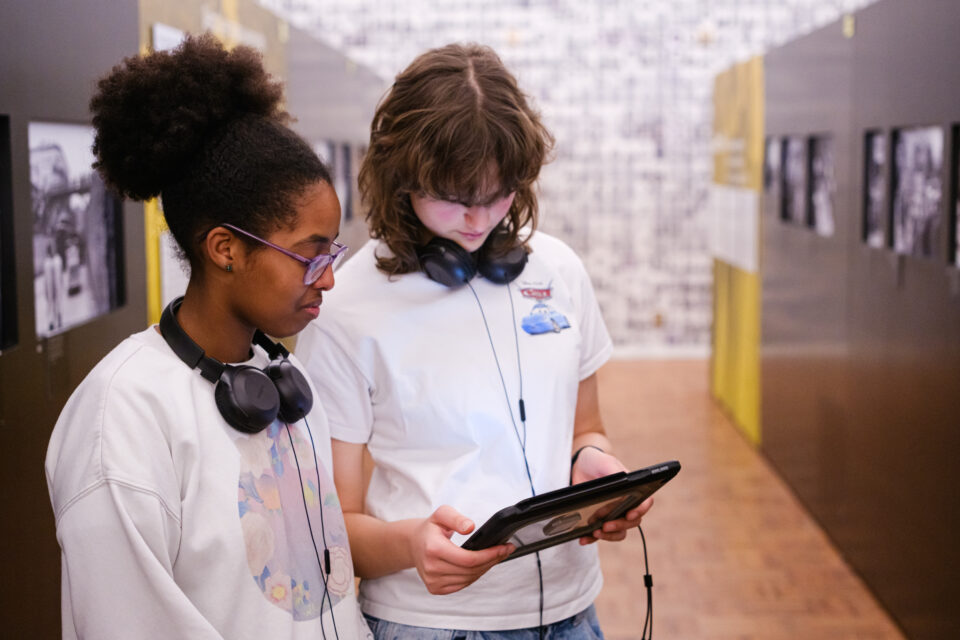

The interactive ‘Living a Life’ tablet tour gives visitors the opportunity to explore Kazerne Dossin at their own pace. It focuses on the story of Holocaust survivor Malvine Löwenwirth, who, as a young woman, experienced the persecution of the Jews in Belgium.
Please note: This tour is only available in Dutch and French
Visitors will explore the museum in pairs (school visits) or in small groups (individual visits). Using audio, video and interactive exercises, they will learn independently and at their own pace. They will look at historical photographs and documents, answer questions and reflect on issues such as migration, discrimination and mass violence today.
‘Living a Life’ is easily understandable and ideal for visitors who enjoy exploring a museum from a personal and active perspective. The tasks carried out in pairs encourage collaboration and peer learning.
Getting started: school visit
- Pupils will work in pairs, using a tablet and headphones.
- A member of staff will be on hand to help set up the tablets.
- To ensure that the visit proceeds calmly and smoothly, we would ask that each group of twenty pupils be accompanied by at least two teachers, who will be on hand to actively supervise and support the group.
- Upon arrival teachers will be provided with a guide containing a map and guidelines on how to supervise the group.
Opgelet: ‘Een leven beleven’ en ‘What’s new’ zijn twee verschillende tablet-tours. In beide tours krijgen de leerlingen een basiskennis over de Holocaust mee, maar de focus en de leerdoelen verschillen. Het aantal deelnemers per tour is beperkt tot 25 leerlingen, aangezien elke tour een vaste looproute heeft en het anders te druk wordt bij de stopplaatsen.
Teaching materials
Preparing for the visit to Kazerne Dossin in the classroom. The Malvine biography and introductory video give pupils the opportunity to gain some knowledge about the museum and its historical context in advance.
Getting started: individual visit
‘Living a Life’ can also be booked as an individual visit (for those aged 14 and over).
The family narrative offers visitors a guide when exploring part of the permanent exhibition. It brings the history of the persecution of the Jews in Belgium to life and encourages people to engage in dialogue with one another. Ideal for pairs or families with teenagers. Even for those who don’t enjoy reading, this tablet tour – featuring audio, video and short texts – is highly recommended.
How does it work?
- You will be given a tablet with two pairs of headphones for every two visitors. If you arrive with an odd number of participants, you will be given an extra tablet and headphones.
- A member of staff will be on hand to help set up the tablets.
The tablet will guide you through the museum and the barracks. - Along the way you will engage in conversation at different locations, discussing what you see.