
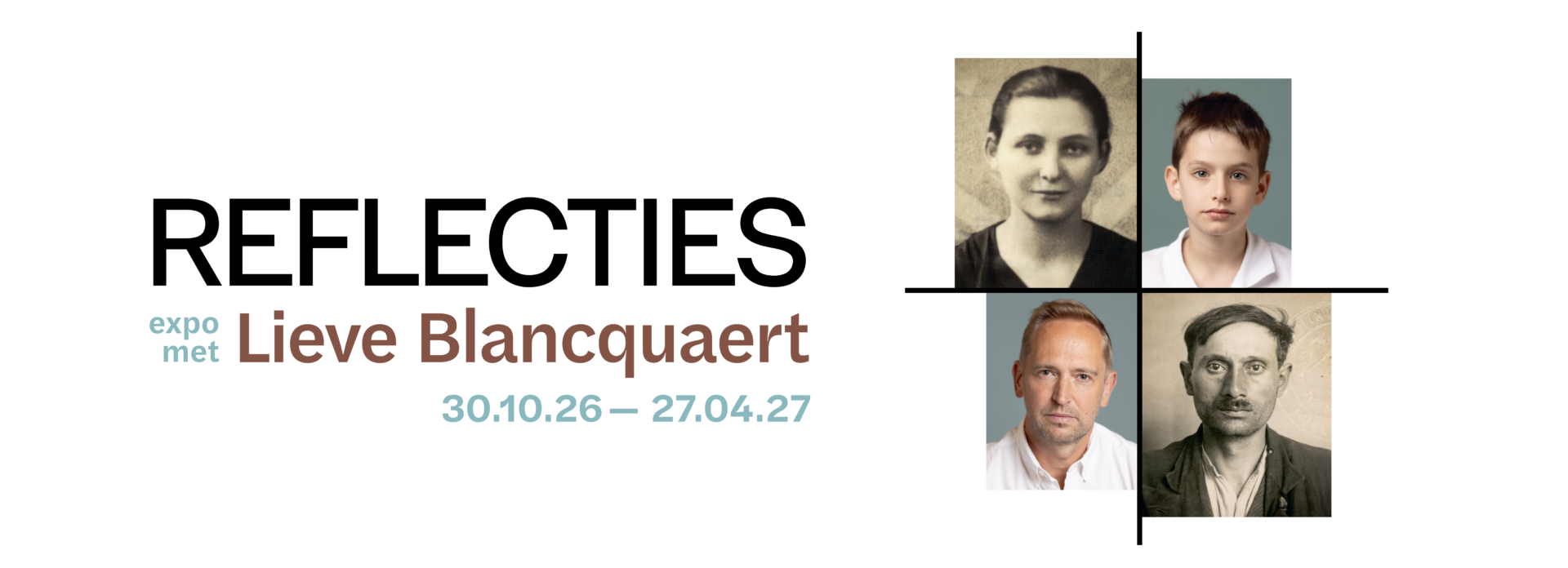
Kazerne Dossin and Lieve Blancquaert open new exhibition
Reflections photo exhibition showcases a contemporary way of remembering
Mechelen, 28/10/2026 – More than three years after the start of the ambitious commemoration project Every Name Matters, Kazerne Dossin presents the two-fold final result: an impressive audio monument and a moving photo exhibition created in collaboration with Lieve Blancquaert.
Audio monument Every Name Matters
With the Every Name Matters project, Kazerne Dossin aimed to commemorate the 25,843 Jews, Roma, and Sinti deported from the Dossin barracks in a personal way. Each name was recorded by a unique voice, resulting in one large audio monument. The link between the participant and the deportee was sometimes based on age, birth date, or name, sometimes on a family bond, but often purely random. The memorial monument—totaling over 50 hours of audio—will now resound permanently and continuously in the memorial site opposite the museum. In the place where their names were taken away, they are now restored.
“History is about real people. As soon as you see their face, you can no longer look away. With this exhibition and the audio monument, we want to touch people and prompt them to reflect.”
— Tomas Baum, Director of Kazerne Dossin
Photo exhibition Reflections
To add a visual dimension to this result, Kazerne Dossin partnered with Lieve Blancquaert. The photographer delved into Kazerne Dossin’s extensive archives and uncovered numerous stories and photos of deportees. This gave her the idea to look beyond the horror: to the lives of these individuals before the atrocities took place.
“A whole new world opened up to me when I dived into the archives of Kazerne Dossin. When you look past the numbers at the faces and stories, you discover who these people truly were. That is perhaps even more moving than the horror itself. In the exhibition, we show the happiness, the connection, and the love between people before their lives were destroyed.” – Lieve Blancquaert
She portrayed and interviewed dozens of participants who had just recorded a deportee’s name. In the exhibition, archival photos and stories of the deported are paired with photos of the matched participants, resulting in a series of dual portraits. Reflections thus places humanity and our contemporary way of remembering at the center.
“It makes you reflect because we are all so similar. But the exhibition also reflects on what is happening in the world today and how that affects us.” – Lieve Blancquaert
Several familiar faces, such as Arnout Hauben, Jacotte Brokken, An Lemmens, and Ilse Liebens, feature in the exhibition. Passersby also posed before the lens, alongside descendants who were able to honor their loved ones in a personal way.
Descendant Cleo Klapholz recorded her great-great-grandfather’s name: “It was a very special experience to speak his name. It gives you a connection to someone you never knew, and that brings up a lot of emotion. I always feel broken when I think of the Holocaust; it is woven into my DNA.“