
Kazerne Dossin’s collection: what Kazerne Dossin collects, preserves and how the collection is made accessible
Kazerne Dossin is more than a museum, it is also a place of remembrance and research. Starting from the Belgian story of the racial persecution of Jews, Roma and Sinti during the Second World War, Kazerne Dossin invites reflection on contemporary phenomena of racism and exclusion. Kazerne Dossin’s archives and museum activities constitute important tools to carry out that mission. Team Collections & Research wrote a collection plan to provide insight into how Kazerne Dossin collects and manages its archives and library. This page provides more information about how the collection is structured, what happens to donated archives and books, and how one can make a donation.
On what subjects does Kazerne Dossin collect archives and publications?
The main focus is the story of the Dossin barracks during the Second World War, when the building was used as an SS assembly camp for Jews, Roma and Sinti. To ensure an accurate historical representation of this camp, a broad framework is needed. The prime focus of Kazerne Dossin’s collection is on:
- The persecution and deportation during the Second World War of Jews, Sinti and Roma living in Belgium and northern France, including themes such as hiding and Jewish resistance.
- Jews, Sinti and Roma deported from the Dossin barracks during the Second World War. This includes both those who officially resided in Belgium and northern France, as well as those who fled from Germany or the Netherlands, for example.
- The history of persecuted Jews, Roma and Sinti and their relatives with a connection to Belgium, including themes such as Jewish refugees from Belgium or those who came to live in Belgium after the war.
The focus of the collection is on the occupation years 1940-1945, but the collection also includes items on the period before and after the war. By also including such documents, the life stories of deportees can be presented in all their facets and the people concerned are not reduced to victims. When collecting documents and photographs from before the Second World War, attention is paid to the migration and refugee background of most of those persecuted. In turn, the postwar items concern reconstruction, restitution, trials, testimonies and trauma.

What does Kazerne Dossin collect?
Kazerne Dossin documents stories of persecuted Jews, Roma and Sinti, those who helped them, and those who participated in their persecution. Items about these various groups are all valuable additions to the collection. The gathering, preservation and accessibility of the archives and library collection is a core task of Kazerne Dossin. In addition, Kazerne Dossin focuses on oral history interviews of Holocaust testimonies.
The collection consists of three subcollections. The first and largest subcollection is the so-called “heritage” subcollection. This collection contains objects, documents, photographs and other historical sources. Kazerne Dossin also collects oral history testimonies and its team also actively interviews witnesses of the Holocaust. The second subcollection is the art collection, which consists of art objects and documents that add context to the preserved works of art. The third subcollection is Kazerne Dossin’s library collection. Kazerne Dossin’s library contains publications on the genocide of Jews, Sinti and Roma, Nazism, antisemitism, human rights violations and genocides, with a special focus on the Belgian case.
For its collection, Kazerne Dossin prefers to receive originals as it is important to safeguard these precious traces of the past and not let them deteriorate. Kazerne Dossin guarantees that these objects, photographs, documents and other items are preserved for the future. We understand, however, that these items have great emotional value for their current owners. In cases where the owners are not ready to donate the originals, Kazerne Dossin digitizes and/or photographs all items, after which their digital representations or reproductions are added to Kazerne Dossin’s collection.
Special attention is paid to oral history: this concerns both testimonies from survivors and stories passed on via children and grandchildren of survivors. Testimonies and interviews can be recorded on site at Kazerne Dossin or at a place that feels familiar to the witness.
What happens to donated archives?
Preservation
For each donation, an official agreement is drafted. That agreement determines how the records will be preserved and made accessible by Kazerne Dossin. The gift agreement is signed by the donor and Kazerne Dossin. Next, the donation is noted in the donation register; this way, the donation can also be mentioned in Kazerne Dossin’s annual report. The archival team of Kazerne Dossin prepares a complete description of the donation, according to international archival rules. From then on, the items are available for consultation and for exhibitions, obviously always with the necessary guarantees regarding security and conservation.
One of the core tasks of Kazerne Dossin is the careful preservation of the collection so that the historical value and integrity of the collected items is preserved. This is done in part by creating good preservation conditions, such as constant temperature and humidity in a safe and secure archival depot. Every incoming donation is cleaned and wrapped in special acid-free paper so that the originals can be preserved for a long time. If an object is fragile, consideration is given to whether additional preservation measures are required. Kazerne Dossin works continuously to improve the physical and digital storage environment. This keeps the collection well protected and accessible for research and exhibitions.
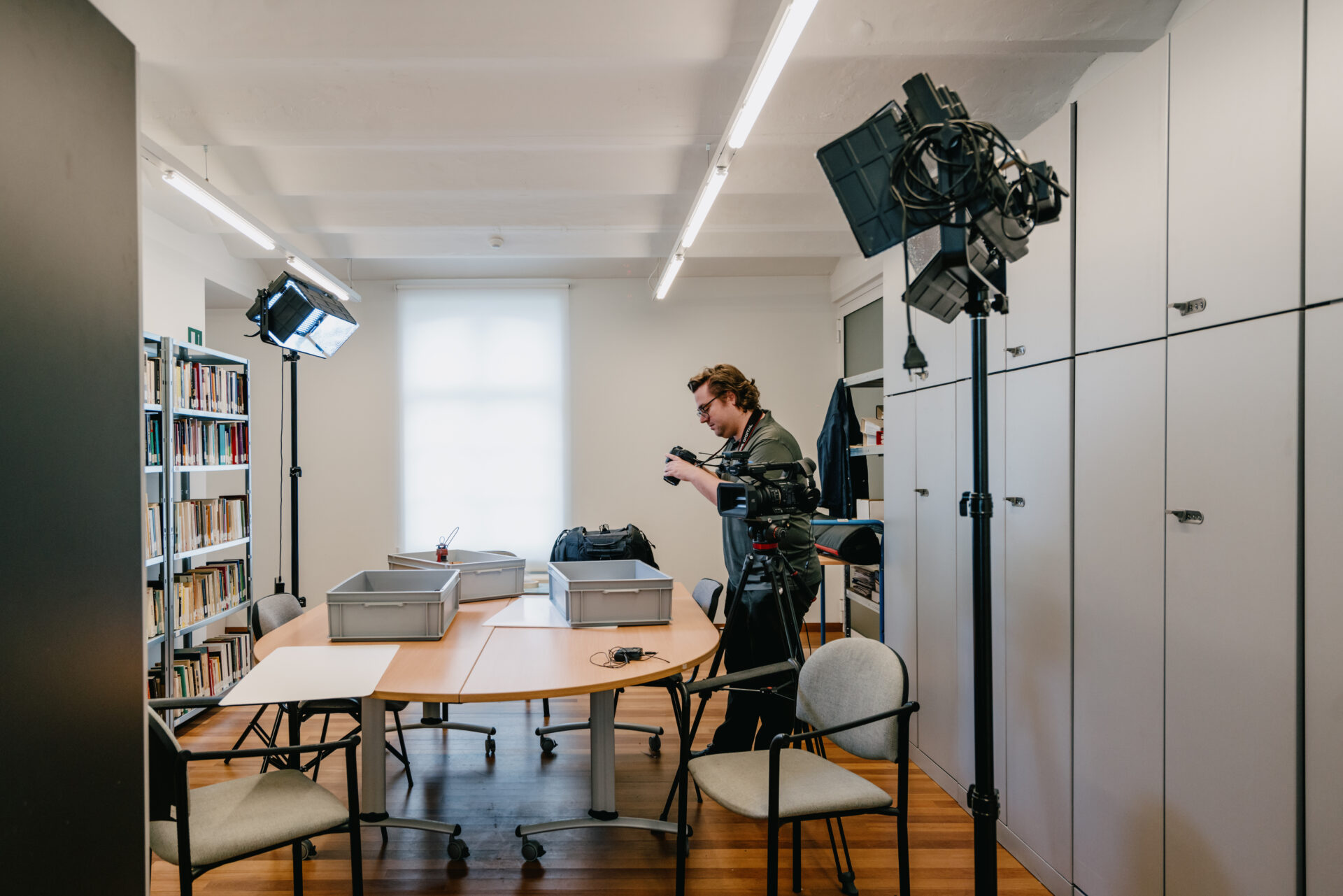
Donations are always digitized; documents and photos are scanned, objects are photographed, and audiovisual files are converted to MP4.
Consultation
Kazerne Dossin’s archival team prepares a collection description for each received donation. After verification by and with the consent of the donor, this description is consequently published in the Kazerne Dossin image bank and on the archival platform of the European Holocaust Research Infrastructure. The collection can be consulted in various ways, always in accordance with privacy legislation.
Kazerne Dossin is actively working on a digital strategy to open up the collection as widely as possible, to share and link data and information. Kazerne Dossin is committed to making all collections from the heritage subcollection available online. The collection descriptions are freely accessible through the image bank. Its library catalog is shared in an online database on Kazerne Dossin’s website.
The actual items from the collections, as well as the publications from the library can only be consulted in Kazerne Dossin’s reading room. Thanks to the extensive digitization policy, over 90% of the heritage subcollection can be viewed digitally in the reading room. To assist family members and researchers abroad in locating data, Kazerne Dossin also has partnerships with archives and museums in the United States of America (USHMM), France (Mémorial de la Shoah) and the Netherlands (Remembrance Center Camp Westerbork). Access to all the records available in Kazerne Dossin’s image bank is also provided in the reading rooms of these partners. Donors receive their own login for the image bank so that they can access their collection from home.
Use of the collection
Within Kazerne Dossin’s work, collection items are used in a variety of ways: Kazerne Dossin uses collection items to develop (temporary) exhibitions, educational initiatives, communications, and its own research and publications. Kazerne Dossin’s Collections & Research team conducts scientific research based on the collection. This has already resulted in many scientific publications and publications for a wider audience.
In addition to its own permanent exhibition, other (temporary) exhibitions were also conceived and designed by Kazerne Dossin. Examples of exhibitions include the Belgian pavilion in Auschwitz-Birkenau and the temporary exhibition Sports and Athletes in KL Auschwitz of 2025 in Kazerne Dossin. Staff also draw on the collection for public engagement activities. Portraits of those deported from the Dossin barracks are being added to the commemorative photo wall in the museum. The portraits were collected as part of the Give them a Face project, but are also used for other initiatives for the general public such as the remembrance project Every Name Counts. Other examples of public outreach include customized museum visits for children and young people.
Kazerne Dossin’s research team also supports research by external researchers. Thanks to the help of Kazerne Dossin’s research center, numerous master’s theses, publications, exhibitions and other projects have already been realized based on the collections kept by Kazerne Dossin. Anyone seeking information – relatives, students, researchers – is welcome, by appointment, to consult the collection. Prior to or at the beginning of the visit, each visitor fills out a short form and is personally assisted by one of the archivists. Kazerne Dossin asks users who write a work based on information from the collection to provide a copy to the research center. Those works are included in the library for other visitors to consult.

How can I offer a donation to Kazerne Dossin?
Individuals or organizations wishing to donate documents, photographs, testimonials, objects and books to Kazerne Dossin can contact the Collections & Research team of Kazerne Dossin at archives@kazernedossin.eu.