
Public Prosecution Service
In order to tackle racism, discrimination and hate crimes constructively, Kazerne Dossin has been collaborating with the Public Prosecution Service since 2021. Prosecutors and judicial assistants can request a guided museum tour at Kazerne Dossin as part of a rehabilitation programme for an offender.
Content
When someone commits a hate crime, they may be offered a rehabilitation programme.
These programmes are aimed at encouraging behavioural change. Unlike punishments,
which are primarily about retribution, offenders are given the opportunity to examine their
own behaviour and learn from it during a rehabilitation programme. This process has an
impact on their self-image and integrity. They also gain an understanding of the options
available to them, which increases their awareness and ability to take action. They are
guided by experienced experts who show them around the unique learning environment at
Kazerne Dossin.
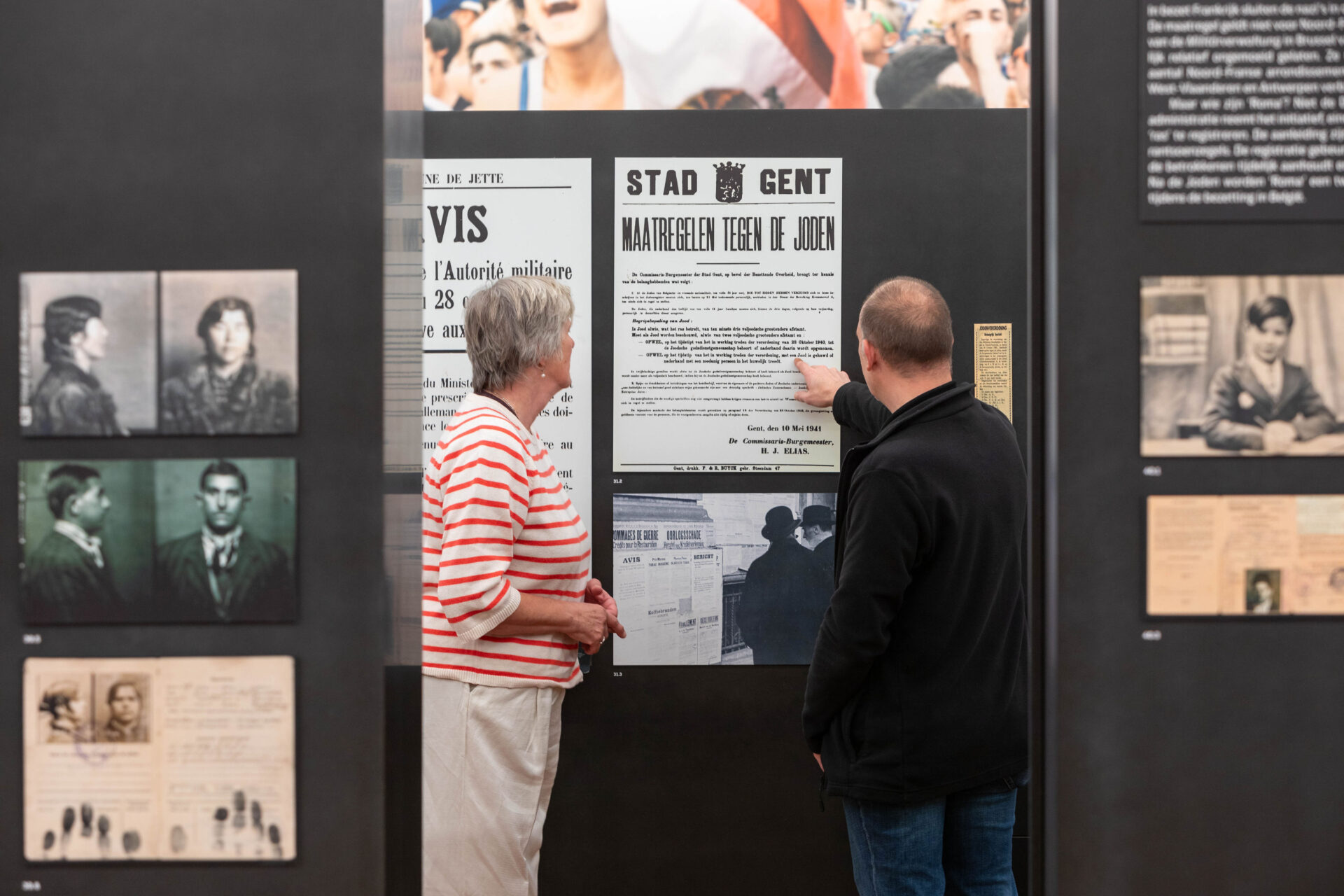
Together with a guide, the participant draws parallels between past events and their own
behaviour in the present. In this way, participants consider cause and effect and reflect on
their own behaviour and its impact on others.
The focus is on personal growth and behavioural change. Respect is key: respect for one
another, for our history and for the community we are part of.
Programme
The Kazerne Dossin learning programme comprises various components, spread over
several weeks:
- To begin with, Kazerne Dossin draws up a detailed profile of each participant. To
this end the participant completes an online questionnaire, which is discussed during
a preparatory meeting. Information from the public prosecutor’s office is also taken
into account. - A suitable guide is then selected for the museum visit, who prepares a guided tour
tailored to the participant and the offence(s) they committed. - A visit to the museum is an in-depth reflective dialogue within the unique learning
environment of Kazerne Dossin, whereby the historical context and stories act as a
catalyst for behavioural change. - The visit is recorded in a written report. The participant completes a reflection based
assignment at home. The guide also writes a detailed report on how the visit progressed. Kazerne Dossin then submits all the documentation to the Public Prosecution Service, together with substantiated advice. - The Public Prosecution Service then decides what action will be taken in this case.
Either the case will be dismissed, or it will be referred to the criminal court.
For whom and by whom?
Applications for the learning programme can be made on behalf of both adults and minors,
provided that there is no risk of violence and the participant is not a known member of an
identitarian network. Minors must be accompanied by at least one parent or guardian
throughout this process.
The facilitators of the learning programmes specialise in conducting challenging discussions
and dealing with hate speech. Their backgrounds are related to education, healthcare and
social work. Before every museum visit, careful consideration is given to which guide would
be the best mentor.
Find out all about the learning programme in this video:
Practical information
Prosecutors and judicial assistants can apply for a training programme online and monitor its
progress via a secure digital platform. Would you like further information about this project?
Or are you handling a dossier that might be eligible for a learning programme?